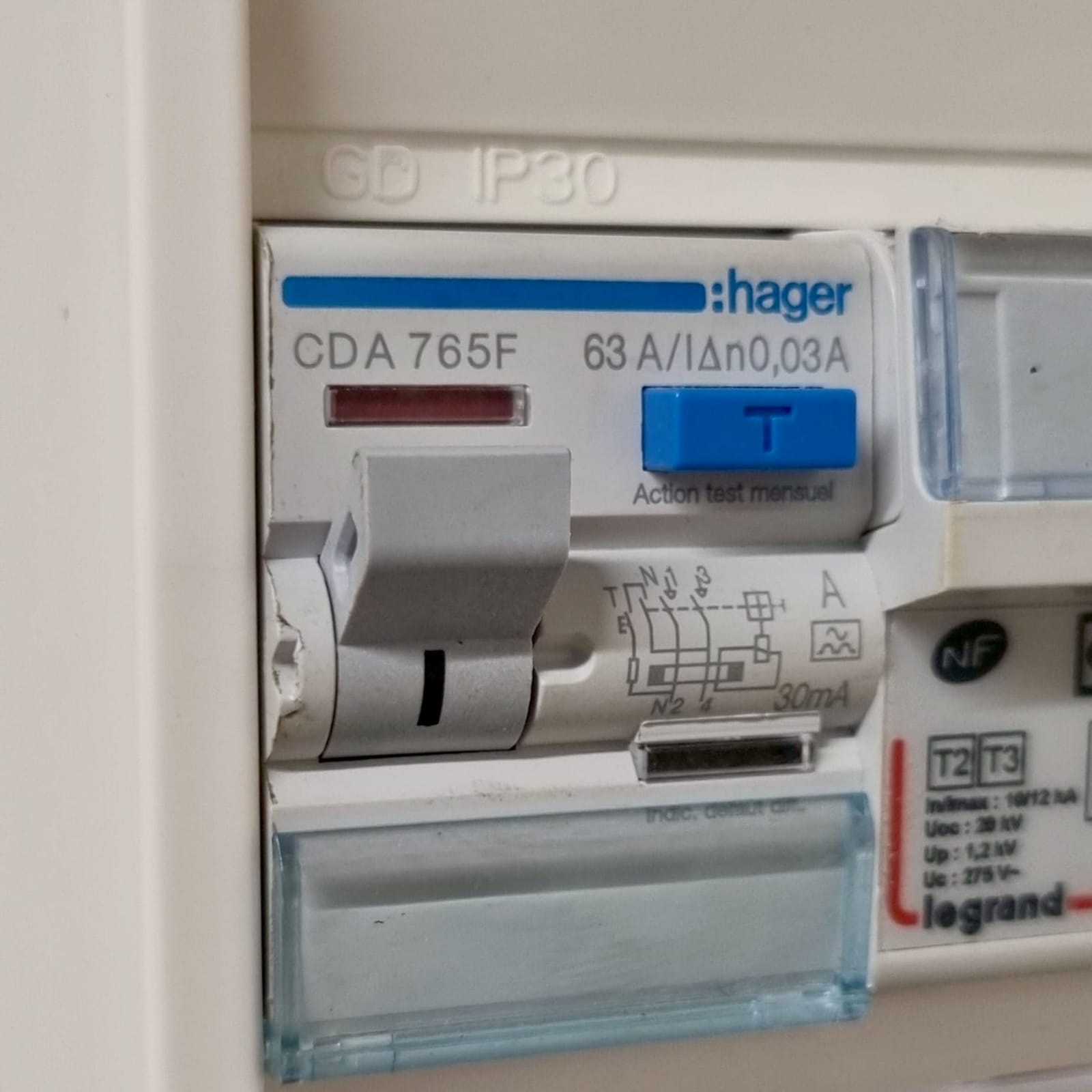
RCD
The test button checks the mechanical and electrical operation of the RCD without touching the wiring.
Published 20 August 2026
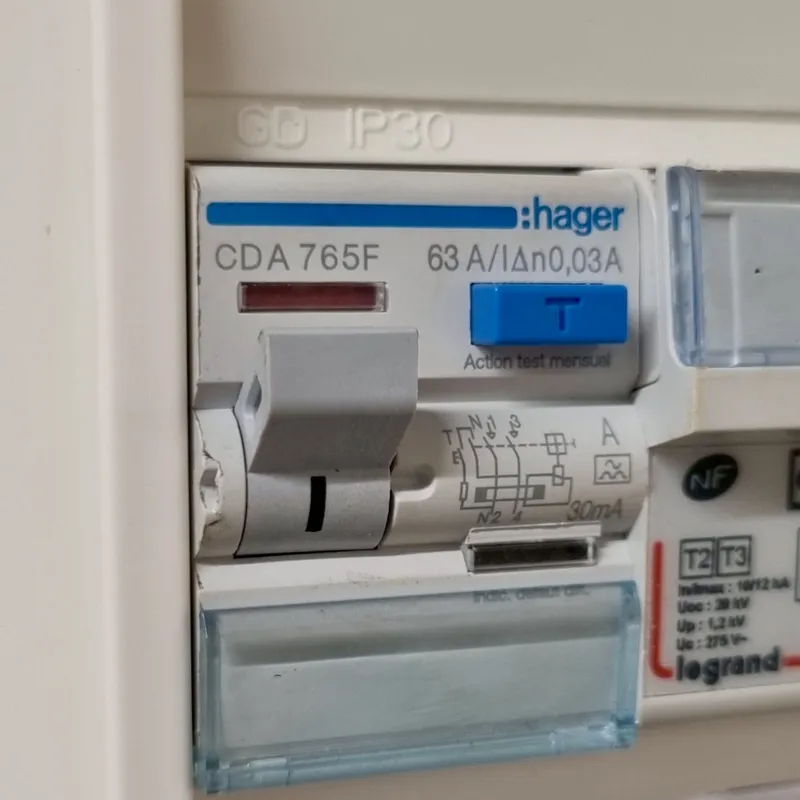 Photo : Sparx Elec image library
 In brief
An RCD trips when it detects current leaking to earth instead of returning on the neutral. The device monitors the balance between the live conductors of the circuit it protects, and the moment that balance breaks, it disconnects the supply almost instantly. In a UK home, a residual current device that keeps tripping is almost always explained by a faulty appliance, moisture, damaged wiring, or a neutral-to-earth fault.
The direct answer to the question in the title is that an RCD does not trip for no reason. It opens the circuit because it measured a difference between the current leaving on the live conductor and the current returning on the neutral, and that difference crossed the trip threshold. Once you understand that the device is reporting a real measurement, the diagnostic becomes a search for where that current is escaping, in a fixed order: connected appliances first, then moisture and wiring, then the device itself.
30 mA
typical RCD sensitivity for personal protection
6 months
recommended interval for the RCD test button
2
protection jobs: RCD for earth leakage, MCB for overload
10
common causes of repeated RCD tripping
A residual current device monitors the current flowing through the live conductors of the circuit or circuits it protects. Under normal conditions, the currents should remain balanced: what leaves on the live conductor returns on the neutral. If some current takes an unintended path to earth, the imbalance can cause the RCD to disconnect the supply.
That is why repeated RCD tripping should not automatically be blamed on the consumer unit. The protective device may simply be responding correctly to a fault elsewhere in the installation. The IET explains that an installation can contain normal standing leakage from electronic equipment, and where several circuits or devices sit behind one RCD, those small leakage currents can accumulate until unwanted tripping becomes more likely.
One important point: an RCD does not normally trip simply because you are using too much electrical power. An MCB responds to overload and short-circuit current, while an RCD responds primarily to residual current or earth leakage. An RCBO combines both functions, so the type of device that has operated matters when diagnosing the problem.
| Device | What it protects against | What repeated tripping may indicate |
|---|---|---|
| Device RCD | What it protects against Residual current / earth leakage | What repeated tripping may indicate A leakage fault on one or more circuits, cumulative leakage, or less commonly an RCD problem |
| Device MCB | What it protects against Overcurrent, overload and short circuits | What repeated tripping may indicate An overloaded circuit, a short circuit, or another overcurrent fault |
| Device RCBO | What it protects against Residual current and overcurrent in one device | What repeated tripping may indicate Either type of fault, so electrical testing may be needed |
Identifying the device that trips narrows the diagnostic (RCD Electrical).
Too many appliances is therefore not a complete explanation for an RCD trip. High demand may operate an overcurrent protective device, while an RCD is concerned with residual current. Multiple appliances can still contribute indirectly if their normal leakage currents accumulate behind the same RCD.
When an RCD trips repeatedly, the cause falls into a small number of families. I work through them in the same order during a diagnostic: connected appliances, moisture, wiring faults, and the device itself. Here is what each one looks like in practice.
A damaged or deteriorating appliance can allow current to leak to earth. Washing machines, dishwashers, kettles, tumble dryers, portable heaters and other equipment can all develop electrical faults. If it is safe to do so, unplug portable appliances on the affected circuit and see whether the RCD can remain on. If one appliance consistently causes the trip when reconnected, leave that appliance unplugged and arrange repair or replacement.
Fixed appliances and equipment can also develop insulation faults. Heating elements are a common area where deterioration can create leakage that appears only when the equipment starts heating or reaches a particular stage of operation. Do not disconnect fixed wiring yourself. Note which appliance was operating when the trip occurred and give that information to the electrician carrying out the diagnosis.
Moisture inside an outdoor socket, garden light, junction box, shed supply or other electrical equipment can create a leakage path to earth. The clue is often that the RCD starts tripping during rain, after heavy weather or when damp conditions increase. Stop using electrical equipment that is visibly wet or damaged, and do not open outdoor fittings to investigate live or fixed wiring.
Attention
An RCD that trips repeatedly is telling you that current is escaping somewhere. Resetting it again and again without finding the leak keeps exposing people and equipment to a latent fault. Damaged insulation does not repair itself, and the leak does not disappear with time.
Cable insulation can be damaged by drilling, screws, crushing, heat, deterioration or previous building work. A wiring fault may be permanent or may only appear when the cable moves, becomes damp or is subjected to a particular load. If unplugging portable appliances makes no difference, fixed wiring becomes a stronger possibility, and proper insulation and circuit testing is then more useful than replacing accessories at random.
A neutral conductor making an unintended connection with earth can cause confusing RCD behaviour. The RCD may trip when another load is switched on, when circuits are restored, or under conditions that do not appear directly connected to the faulty point. Neutral-to-earth faults require electrical testing. They should not be investigated by removing consumer-unit covers, disconnecting neutrals or experimenting with fixed wiring.
Electronic equipment can produce small amounts of normal protective-conductor current. One item may not be enough to operate the RCD, but the combined leakage from many devices can make unwanted tripping more likely, particularly where one RCD protects several circuits. The IET notes that a 30 mA RCD does not necessarily wait until exactly 30 mA before operating. This is one reason circuit design and accumulated standing leakage matter.
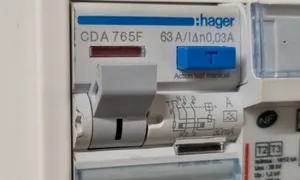
RCD
The test button checks the mechanical and electrical operation of the RCD without touching the wiring.
Physical damage, contamination, water ingress or deteriorated wiring at an accessory can create an earth-leakage fault. Discolouration, cracking, buzzing, heat or visible damage are reasons not to keep using the affected point. If there is heat, arcing, smoke or a burning smell, treat it as an urgent electrical problem rather than repeatedly resetting the RCD.
Incorrect neutral connections, shared or borrowed neutrals and wiring mistakes introduced during alterations can cause RCD or RCBO tripping. The problem may first become obvious after a new circuit, lighting alteration or consumer-unit change. Tell the electrician if the tripping started immediately after electrical work, because that history can significantly narrow the diagnostic process.
Some faults appear only during start-up, shutdown, heating cycles or other temporary operating conditions. Electronic filters and capacitive loads can also contribute to standing or transient leakage. Record the time of the trip, the equipment running at that moment and whether weather or heating cycles appear relevant. Patterns often provide more useful information than repeatedly resetting the device.
The RCD itself can fail or operate incorrectly, but it should not be blamed simply because it keeps tripping. Connected loads, leakage within the installation and other circuit conditions can influence RCD behaviour. If installation faults and connected equipment have been properly ruled out, an electrician can test the protective device and determine whether replacement is appropriate. Repeated tripping alone does not mean the whole consumer unit needs replacing.
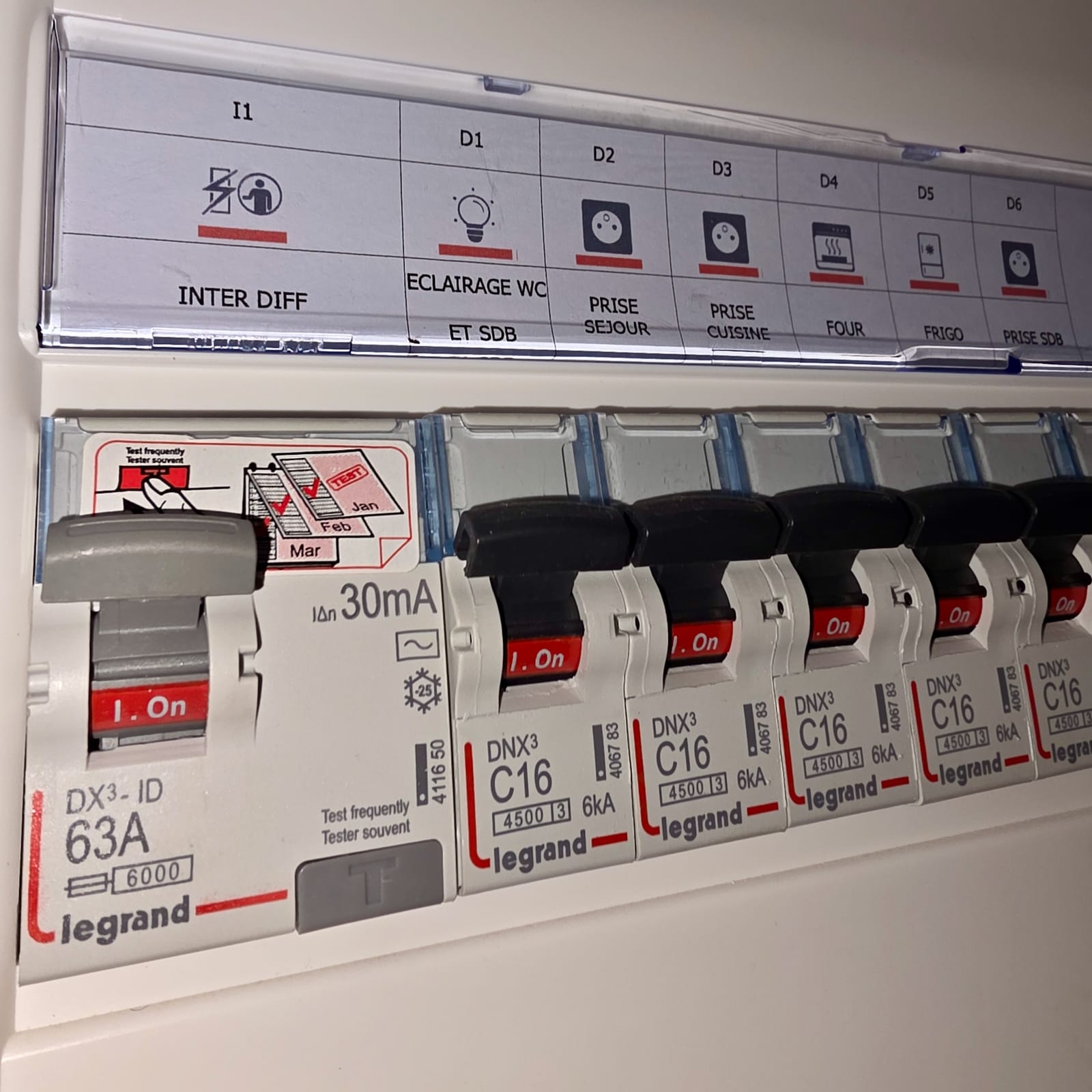
Consumer unit with RCD
The reading starts with the 30 mA sensitivity on the RCD, then the circuit breakers that feed each circuit.
Homeowner troubleshooting should stay at observation and normal user controls. Do not remove the consumer-unit cover, disconnect fixed wiring or use electrical test equipment unless you are competent to do that work. Do not bypass an RCD, hold it in the ON position or replace it with a different rating simply to stop the tripping. The reason for the operation needs to be established first.
If an RCD trips immediately every time it is reset, there may be a persistent leakage fault on a connected circuit, a fixed appliance fault, a neutral-to-earth problem or an issue with the RCD itself. If accessible portable appliances have been unplugged and the RCD still will not remain on, repeatedly resetting it is unlikely to identify the problem. At that point, targeted electrical testing is usually more appropriate.
Info
The current IET guidance says the integral RCD test button should be operated at six-monthly intervals. The test button checks the mechanical and electrical operation of the device; it does not prove that the fixed wiring or connected appliances are fault-free. If the test button does not cause the RCD to operate, or the device cannot be reset afterwards, arrange an electrical assessment rather than assuming the protection is working normally.
Professional fault finding aims to establish whether the leakage comes from connected equipment, one particular circuit, the fixed installation or the RCD itself. Depending on the fault, the electrician may inspect the installation, separate likely sources, carry out appropriate dead testing, measure leakage current and test the protective device. The exact sequence depends on the evidence found at the property rather than one universal test.
The IET explains that where leakage is detected, individual circuits and equipment can be isolated and tested to identify the affected part of the installation. This is why targeted diagnosis is more reliable than changing the RCD or consumer unit without evidence.
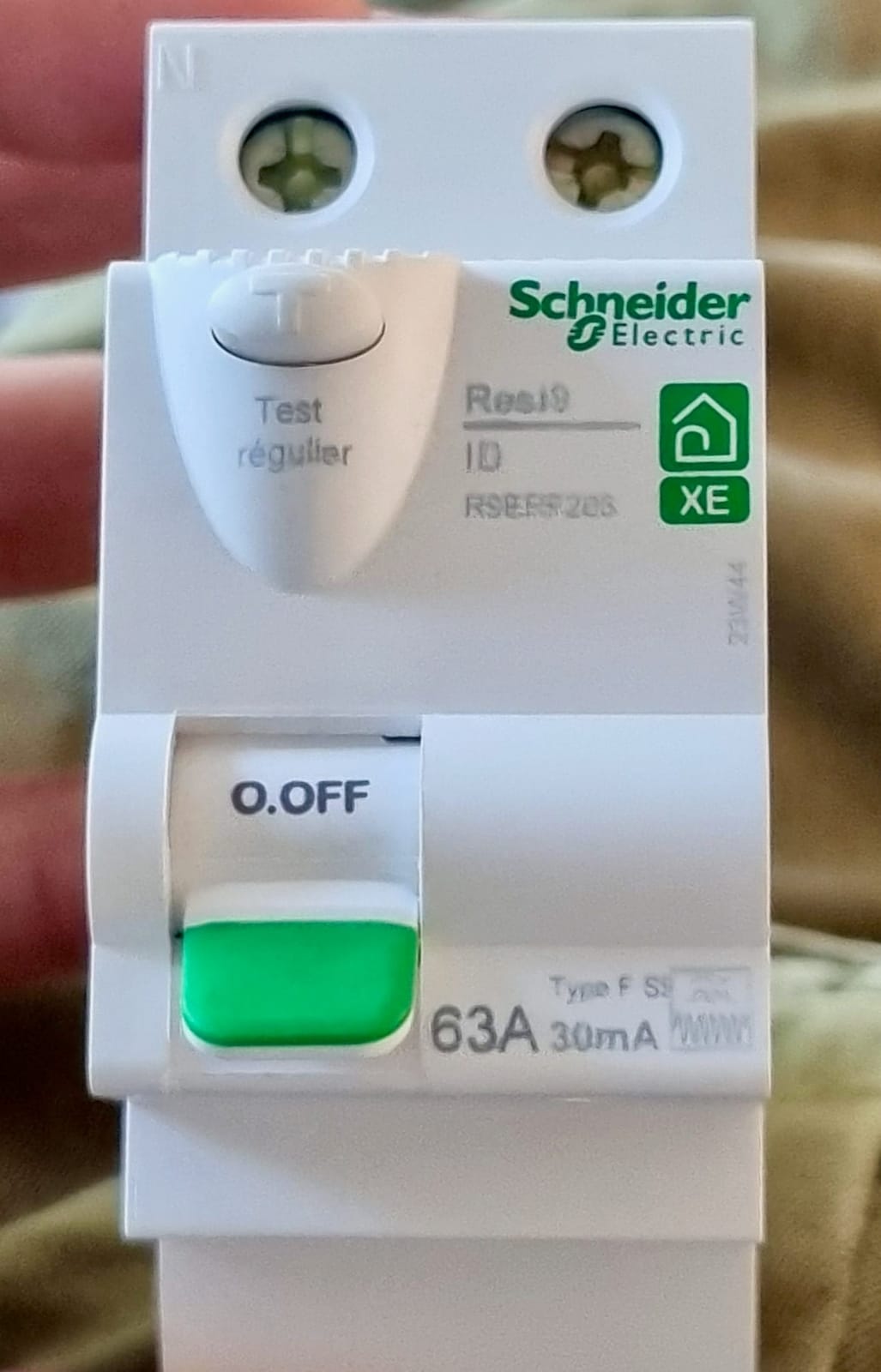
Type F RCD
The type is printed on the front face: type F for circuits with variable-speed drives, 30 mA for personal protection.
Not automatically. Replacing the RCD before checking the installation can hide the real diagnostic question: what current is causing it to operate? A replacement may be appropriate if testing confirms the device is defective, damaged or unsuitable for the installation. But if the real problem is a faulty appliance, water ingress, damaged wiring or excessive cumulative leakage, changing the RCD alone will not correct that cause.
The same principle applies to RCBO upgrades. Individual RCBO protection can reduce the number of circuits lost when one circuit develops a fault, but an RCBO does not remove the underlying electrical defect.
Repeated RCD tripping needs investigation, but not every trip is automatically an emergency call-out. The level of urgency depends on the accompanying symptoms. Arrange urgent electrical help if the tripping is associated with heat, arcing, smoke, a burning smell, or any visible damage to an accessory or cable. These situations move beyond ordinary troubleshooting and require immediate attention.
Intermittent RCD faults are often harder to trace because the electrical condition may not be present when someone first inspects the property. The trip can depend on the weather, on which appliances are running, or on the temperature of a heating element. That is why the pattern of the trips matters as much as the trips themselves.
A few clues help narrow the search. If the problem mainly occurs during rain or after heavy weather, moisture ingress in an outdoor circuit is the first suspect. If it happens when a specific appliance starts, that appliance is likely leaking. If it happens at night even though nothing obvious appears to be running, a fixed appliance with a standby circuit or a heating element is a strong candidate. Recording the time of each trip, the equipment running at that moment and the weather gives an electrician the evidence needed to isolate the fault quickly.
The reason intermittent faults are so common is that leakage current is not constant. A damaged cable may only leak when it moves, when it becomes damp, or when it carries a particular load. A heating element may only leak once it reaches a certain temperature. The RCD is doing its job every time; the fault simply is not always present to be measured.
If an RCD trips immediately every time it is reset, there may be a persistent leakage fault on a connected circuit, a fixed appliance fault, a neutral-to-earth problem or an issue with the RCD itself. The immediate retrip is actually useful information: it tells you the fault is present right now, not intermittent.
If accessible portable appliances have been unplugged and the RCD still will not remain on, repeatedly resetting it is unlikely to identify the problem. At that point, targeted electrical testing is usually more appropriate. An electrician can isolate circuits one at a time to find which one holds the fault, then measure the leakage on that circuit to locate the exact point.
Understanding the three devices avoids a common mistake: assuming every trip is the same problem. An RCD reacts to residual current, meaning current leaking to earth. An MCB reacts to overcurrent, meaning overload or short circuit. An RCBO combines both, so it can trip for either reason.
When a device trips, the first question is which one it was. If it was an MCB, the circuit is overloaded or shorted. If it was an RCD, current is leaking to earth. If it was an RCBO, either condition is possible and testing may be needed to tell them apart. This distinction alone often cuts the diagnostic time in half, because it tells you which family of faults to look for.
The test button on an RCD is a small but important control. Pressing it injects a test current that simulates an earth fault, forcing the device to operate. If the RCD trips, the detection and the mechanical mechanism are working. If it does not trip, or if it cannot be reset afterwards, the device needs assessment.
The test button does not prove that the fixed wiring or connected appliances are fault-free. It only proves that the RCD itself can detect a fault and open the circuit. That is why the six-monthly test is a complement to, not a replacement for, proper inspection and testing of the installation.
A professional diagnostic follows the evidence rather than a fixed script. The electrician starts by asking when the trips happen and what was running, then inspects the consumer unit and the circuits. Depending on what they find, they may isolate likely sources, carry out dead testing, measure leakage current on individual circuits, and test the protective device itself.
The goal is to establish where the leakage comes from: connected equipment, one particular circuit, the fixed installation, or the RCD. Once the source is identified, the repair is usually straightforward. The important point is that the diagnosis comes before any replacement, so that the RCD or consumer unit is only changed when the evidence says it is the problem.
The most common mistake is treating the RCD as the enemy. Bypassing it, holding it in the ON position, or fitting a different rating to stop the tripping removes the protection that keeps people safe. The RCD is not the problem; it is reporting a problem.
The second mistake is replacing the RCD or the whole consumer unit without finding the cause. If the real fault is a leaking appliance, water ingress or damaged wiring, a new device will trip exactly the same way. The money is better spent on the diagnostic.
The third mistake is ignoring the pattern. A trip that only happens in the rain, or only when a specific appliance runs, is a strong clue. Writing down when trips happen and what was running at the time is the cheapest and most useful step a homeowner can take.
A trip at night usually points to a fixed appliance or wiring fault rather than a portable device. Heating elements, immersion heaters and appliances with standby circuits can leak current only when they reach a particular stage of operation. If the trip happens overnight, note which equipment was running and ask an electrician to test the fixed circuits.
No. An RCD protects people against earth leakage, while an MCB protects the wiring against overload and short circuits. An RCBO combines both functions in one device. Identifying which one tripped tells you whether the fault is a leak to earth or an overcurrent.
The IET recommends operating the test button every six months. The test checks the mechanical and electrical operation of the device, not the state of the wiring or your appliances. If the button does not trip the RCD, or the device cannot be reset, arrange an electrical assessment.
Not automatically. If the cause is a faulty appliance, water ingress, damaged wiring or cumulative leakage, changing the RCD will not correct it. A replacement is only appropriate if testing confirms the device itself is defective. Find the cause first, then decide.
Tripping during rain is a strong clue for moisture ingress in an outdoor socket, garden light, junction box or shed supply. Water creates a leakage path to earth that disappears when the weather dries out. Stop using the affected equipment and have the outdoor circuit inspected.

Théo Desrousseaux
Electrician and editor
I work in the field and edit this magazine. Every guide is reviewed for its target country before publication.
Sources and references
Practical electrical installation guides, diagnostic methods and tool recommendations compared against the technical wiring standards of this national edition.
What is the difference between an RCBO and an RCD? Learn what each device protects, why RCBOs trip less, the cost in the UK, and which to choose.
Read the guide Guide Ring main circuit wiring UK BS 7671 How does a UK ring main circuit work? Learn the BS 7671 433.1.204 rule, the 100 m² limit, the 32 A protection, spurs, and how the circuit is wired. Read the guide
  Guide UK 13 amp socket types BS 1363 explained What are the UK 13 amp socket types? Learn the BS 1363 plug, the fuse in the plug, safety shutters, the Type G standard, and how the system works. Read the guide
  Guide Best multimeter for electricians UK What is the best multimeter for electricians in the UK? Compare the Fluke 87V, Fluke 117, Klein MM700 and Brymen BM235, with prices, CAT ratings and True RMS. Read the guide