


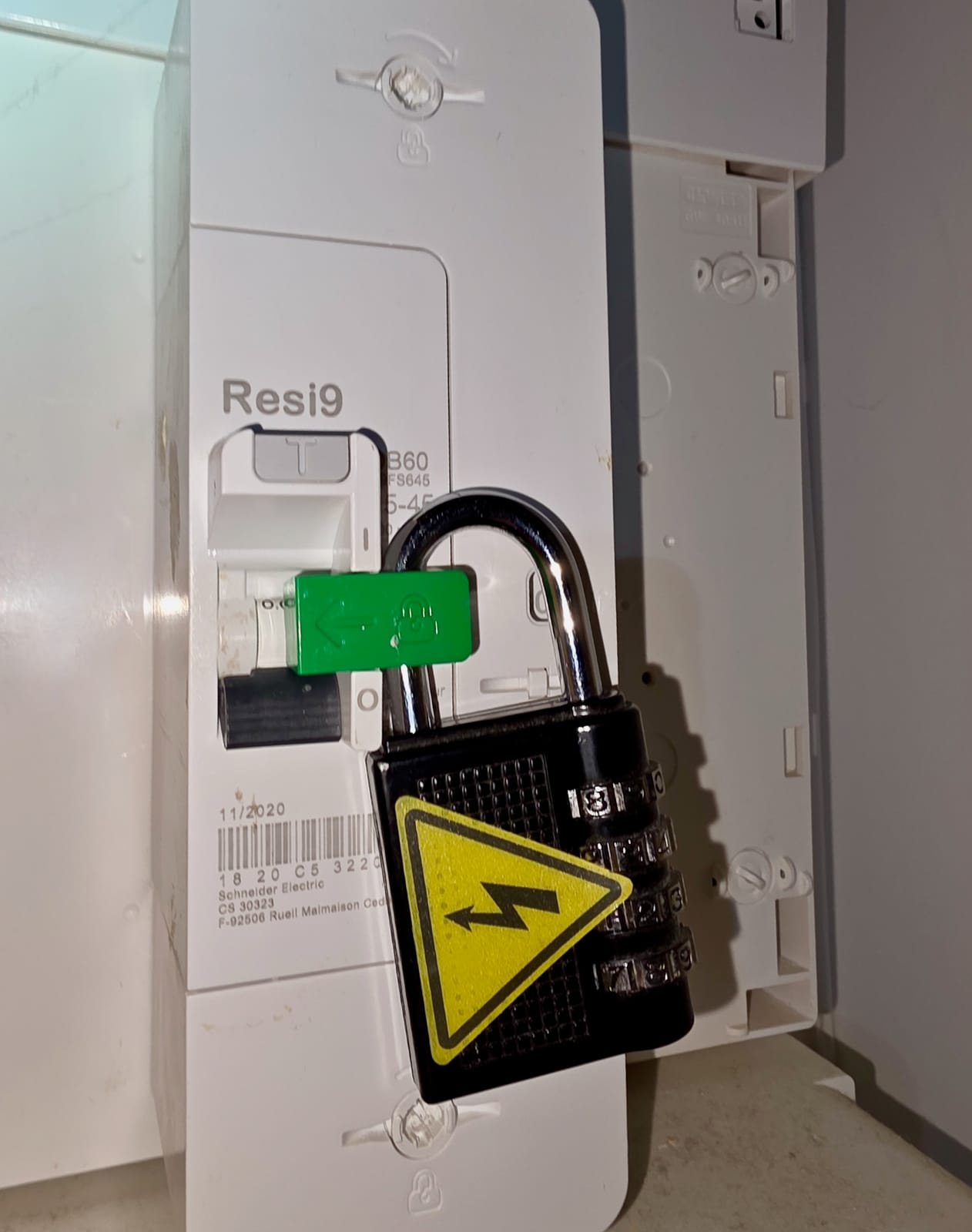
Disjoncteur condamné par cadenas
Le verrouillage imposé par le gestionnaire de réseau est le repère qui distingue cet appareil de tout disjoncteur du tableau.
Publié le 7 août 2026
 Photo : cdn.etap.com
 En bref
When you arrive on a French site after training under BS 7671, the NEC or another national code, the consumer unit is usually the first thing that looks foreign.
I am an electrician based in La Celle-Saint-Cloud, west of Paris, and I regularly work alongside colleagues trained abroad, so I hear the same questions every year: why two RCDs, why 30 mA on everything, why is the main switch sealed, and who exactly is Consuel.
The short answer is that the French electrical panel is governed by NF C 15-100, made mandatory for new buildings by article R 111-12 of the construction and housing code and the 22 October 1969 order. Before the distributor energises an installation, an attestation must be completed by the installer and vetted by Consuel.
This article explains the rules I check on every French consumer unit: the figures confirmed by official sources, and the points where the published guides diverge — left out rather than guessed.
If you work between countries, my comparison of Belgian and French rules covers the RGIE side of the border.
30 mA
RCD sensitivity required on every circuit
8
circuits maximum per RCD
20 %
spare modules required in a house board
1964
year Consuel was created
NF C 15-100 is the French standard published by AFNOR that covers the design, execution, verification and maintenance of low-voltage electrical installations, that is below 1 000 V AC and 1 500 V DC.
The 2024 series is made of 21 standards — NF C 15-100-1, the -7-7xx parts, -8-1, -10 and -11 — each covering a specific type of installation or requirement.
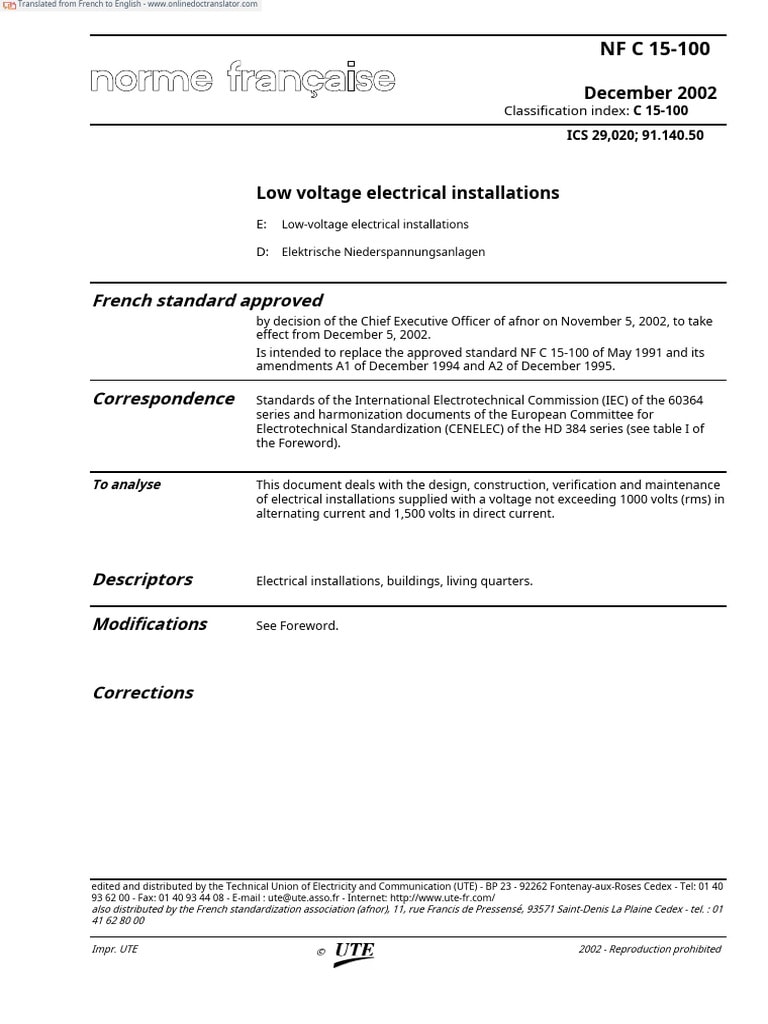
The obligation itself does not come from the standard but from the building code. Article R 111-12 of the construction and housing code, together with the order of 22 October 1969, requires the electrical installations of new buildings to comply with NF C 14-100 and NF C 15-100 as in force at the time of construction.
NF C 14-100 is the connection standard, NF C 15-100 is the internal installation standard.
The version that applies is the one in force on the date the planning permission or the prior declaration was filed. This detail matters more than most people think, because two editions are currently in circulation.
According to AFNOR, the 2002 edition with its amendments A1 to A5 remains the version of mandatory application under the order of 3 August 2016, because the 2024 series is not yet referenced in the regulations.
The 2024 series does apply to new installations and to extensions and modifications since September 2025, but its regulatory status is not yet final.
Promotelec summarises the same timeline more simply: the 2024 version has been applicable since September 2024 and becomes mandatory in September 2025, making the 2002 edition obsolete. When the two readings differ, I follow AFNOR on the regulatory status, because AFNOR is the publisher of the standard.

One practical consequence for a foreign electrician: the official text is published in French only, the 2002 edition is freely consultable, and the 2024 edition is paying. Budget for the language barrier and check the edition before you quote a job.
Attention
English-language guides on NF C 15-100 exist, and some carry figures I do not reproduce. One popular guide states a 30 % spare-module rule, which contradicts the 20 % figure published by Legrand, and gives calibres for lighting and socket circuits that my official sources do not confirm. When a guide and a manufacturer disagree, I check the standard text itself.
The French consumer unit lives in a dedicated technical space called the ETEL (Espace Technique Électrique du Logement). It is a floor-to-ceiling volume of at least 60 cm wide and 25 cm deep, reducible to the width of the GTL plus 10 cm.
The ETEL is mandatory for new builds, full renovations and consumer unit renovations; it is not required for a renovation without redistribution.
There are placement rules you will not find in most other codes. The ETEL is forbidden in bathrooms, humid or dusty rooms and under staircases. It must sit at least 10 cm from a gas installation, 40 cm from a heat source and 60 cm from a water point, and a 70 cm clear passage is recommended in front of it.
Inside the ETEL, the GTL groups the goulotte, the control panel with the meter and the main switch, the consumer unit itself, the communication enclosure and two 16 A sockets on a dedicated circuit. Strong-current circuits, above 50 V, and weak-current circuits, below 50 V, must run in separate pathways.
The communication enclosure is a French specificity that many foreign electricians overlook — I covered its rules separately.
The two 16 A sockets of the GTL are not ordinary outlets: they are fed by their own dedicated circuit, so they stay independent of the general socket circuits. I plan them inside the ETEL volume from the start and give them a separate MCB in the board, because a foreign-trained eye tends to treat them as an afterthought.
Operating devices must be installed at a height between 0.90 m and 1.80 m, a range reduced to 0.50 m when the unit is behind a door. The main board itself must have at least two rows, so that the loads can be balanced between the type A and type AC RCDs.
I detailed the height rule in a dedicated guide.
French regulations require an emergency disconnection that removes power from the home in a single gesture, accessible from inside the dwelling. In practice, this role is played by the disjoncteur de branchement (the service cut-out, sometimes called AGCP), installed and sealed by Enedis, the grid operator.
Disjoncteur condamné par cadenas
Le verrouillage imposé par le gestionnaire de réseau est le repère qui distingue cet appareil de tout disjoncteur du tableau.
The rating of this breaker follows the subscribed power, with 60 A recommended for older homes. The installer never touches the sealed breaker: the connection work stops at the consumer unit, which is linked to the service cut-out by a 16 mm² conductor.
This is the part of the French system that surprises electricians from countries where the main switch is an ordinary part of the consumer unit.
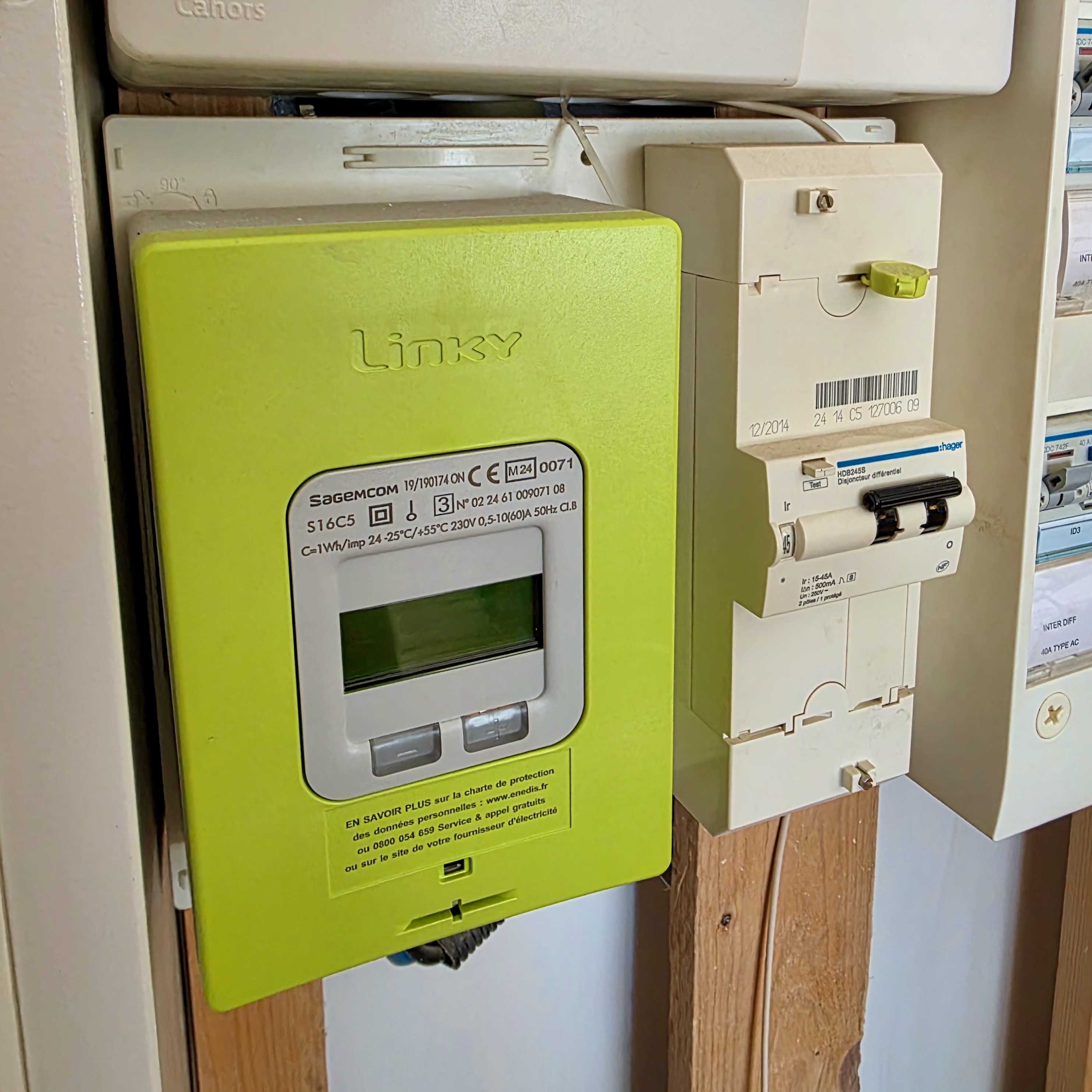
The connection side is governed by NF C 14-100, the companion standard to NF C 15-100. If a job requires more subscribed power, the request goes through the grid operator, not through a modification of the sealed breaker.
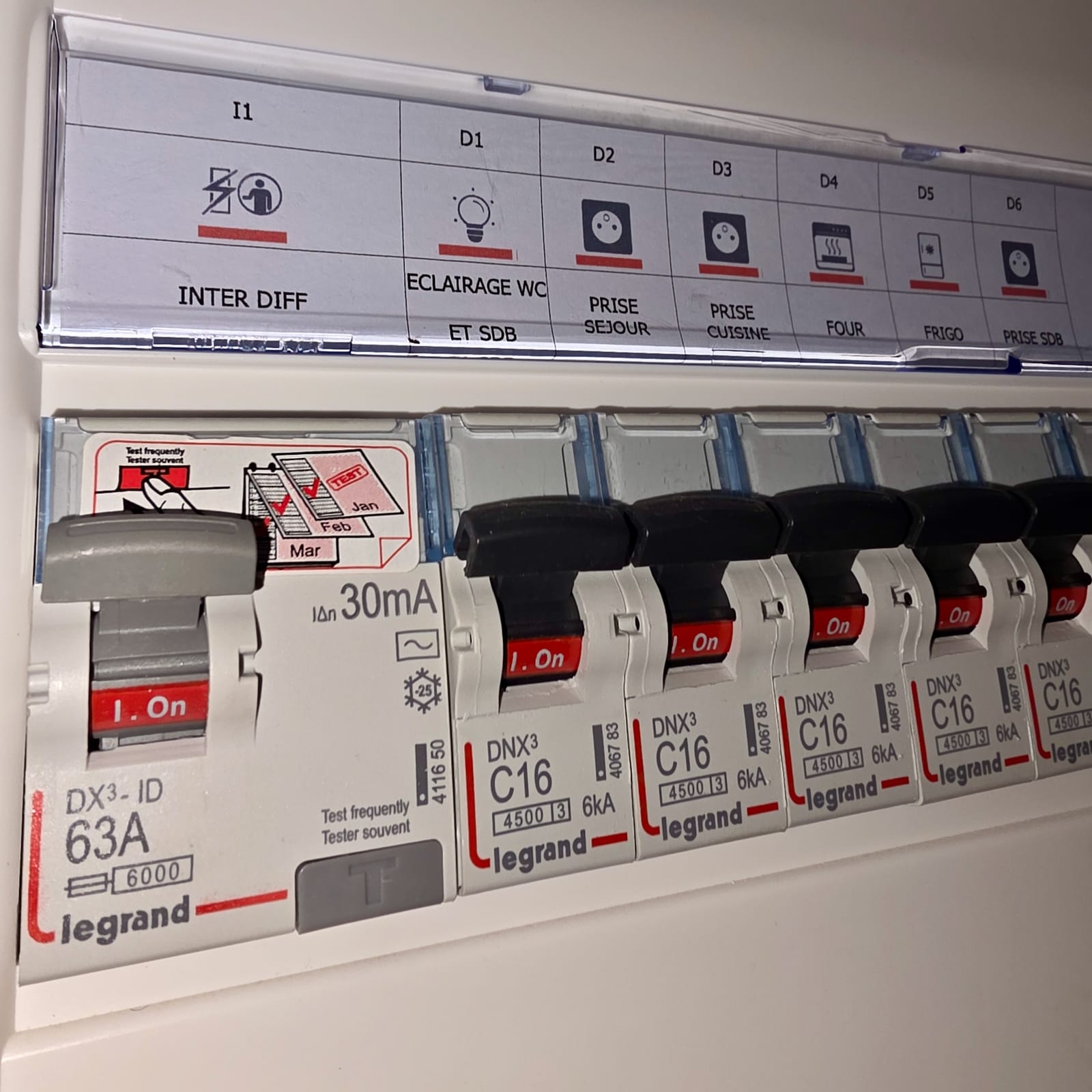
The rule that most defines the French approach is the systematic use of residual current devices at 30 mA. NF C 15-100-10 requires 30 mA sensitivity on every circuit, lighting included, which is broader than BS 7671 or NEC practice in most domestic situations.
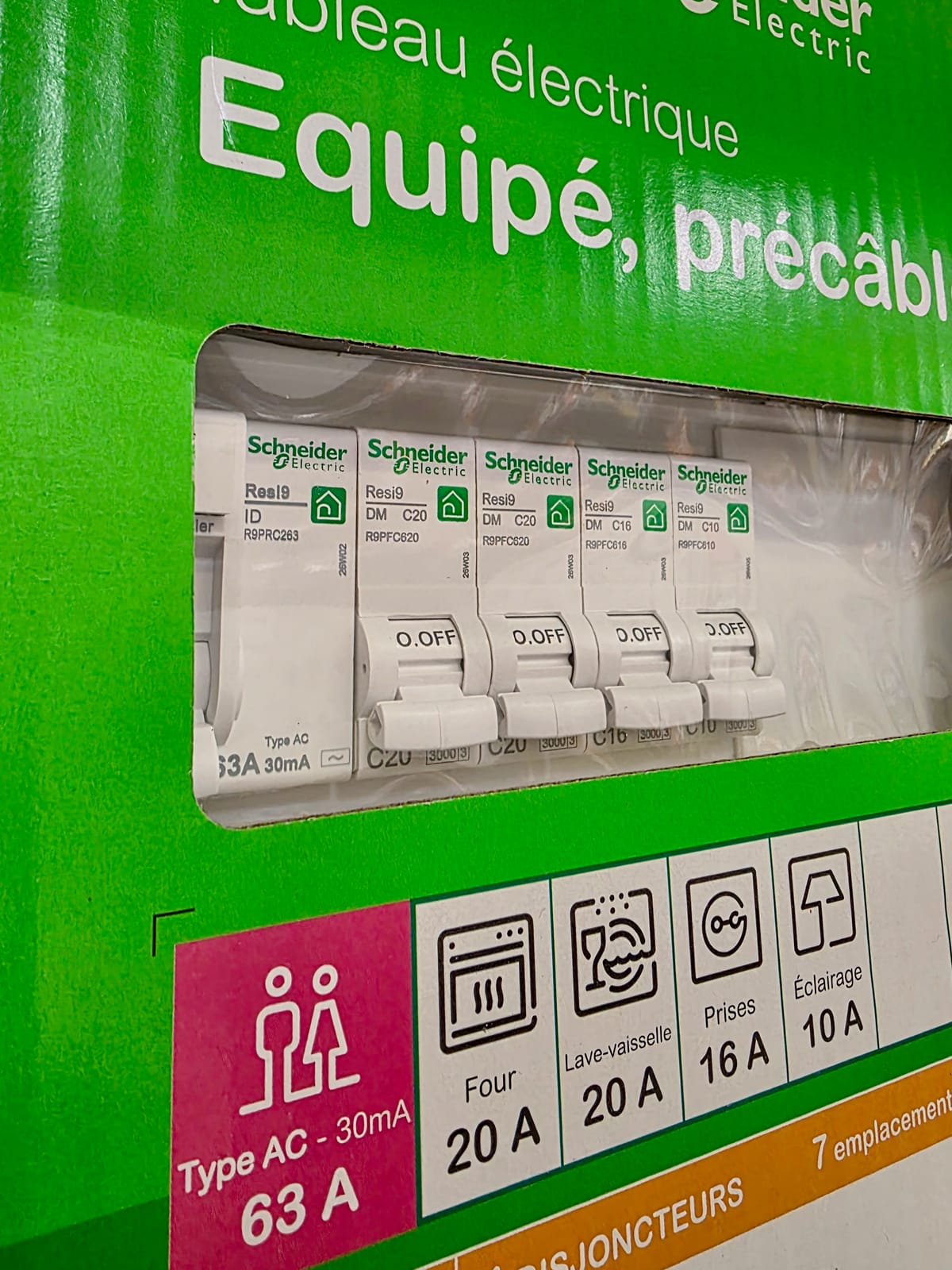
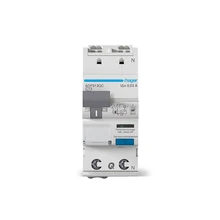
Différentiel 30 mA
Repérez l'appareil plus large que les disjoncteurs qui l'entourent : c'est lui qui porte la sensibilité exigée sur chaque circuit.
A dwelling must have at least two RCDs: one type A and one type AC, each protecting 8 circuits maximum.
The type A is required for the cooker hob, the washing machine and the EV charging socket; the type F is mandatory for air conditioning, pool pumps and heat pumps, and recommended for reinforced sockets and charging stations.
| RCD type | Where NF C 15-100 requires it | Typical French use |
|---|---|---|
| RCD type Type AC | Where NF C 15-100 requires it Standard circuits | Typical French use The second RCD of the board, protecting general sockets and lighting |
| RCD type Type A | Where NF C 15-100 requires it Cooker hob, washing machine, EV charging socket | Typical French use One of the two mandatory RCDs of the home board |
| RCD type Type F | Where NF C 15-100 requires it Air conditioning, pool pump, heat pump | Typical French use Mandatory on those circuits, recommended for reinforced sockets and charging stations |
RCD types according to Legrand’s summary of NF C 15-100.
The 8-circuit limit per RCD is a sizing rule that does not exist in many countries, where the only limit is the RCD rating itself. It forces a deliberate split of circuits between the two differential devices, and it is one of the first things I check when I take over a board built by a foreign-trained colleague.
Two related questions come up constantly on site. First, the difference between an RCD and an RCBO, which I explain in a dedicated comparison.
Second, what to do when a 30 mA RCD keeps tripping for no apparent reason — I wrote a troubleshooting guide for that exact symptom. The type question, AC, A or F, also has its own article.
Because this article is aimed at electricians trained abroad, a vocabulary map helps. The interrupteur différentiel is the RCD, the disjoncteur divisionnaire is the MCB, the tableau électrique is the consumer unit, and the disjoncteur de branchement is the main switch.
The newer protective devices keep their acronyms in French catalogues: RCBO and AFDD are used as such.
Info
The 30 mA requirement applies to lighting circuits too, which is unusual for electricians trained under BS 7671 or the NEC. A lighting circuit without its 30 mA RCD is a non-compliance that Consuel will flag.
Each circuit is protected by its own MCB (disjoncteur divisionnaire). The striking part for foreign electricians is that fuses and fuse carriers are banned in new installations and major renovations: they are replaced by MCBs, one per circuit, sized to the conductor.
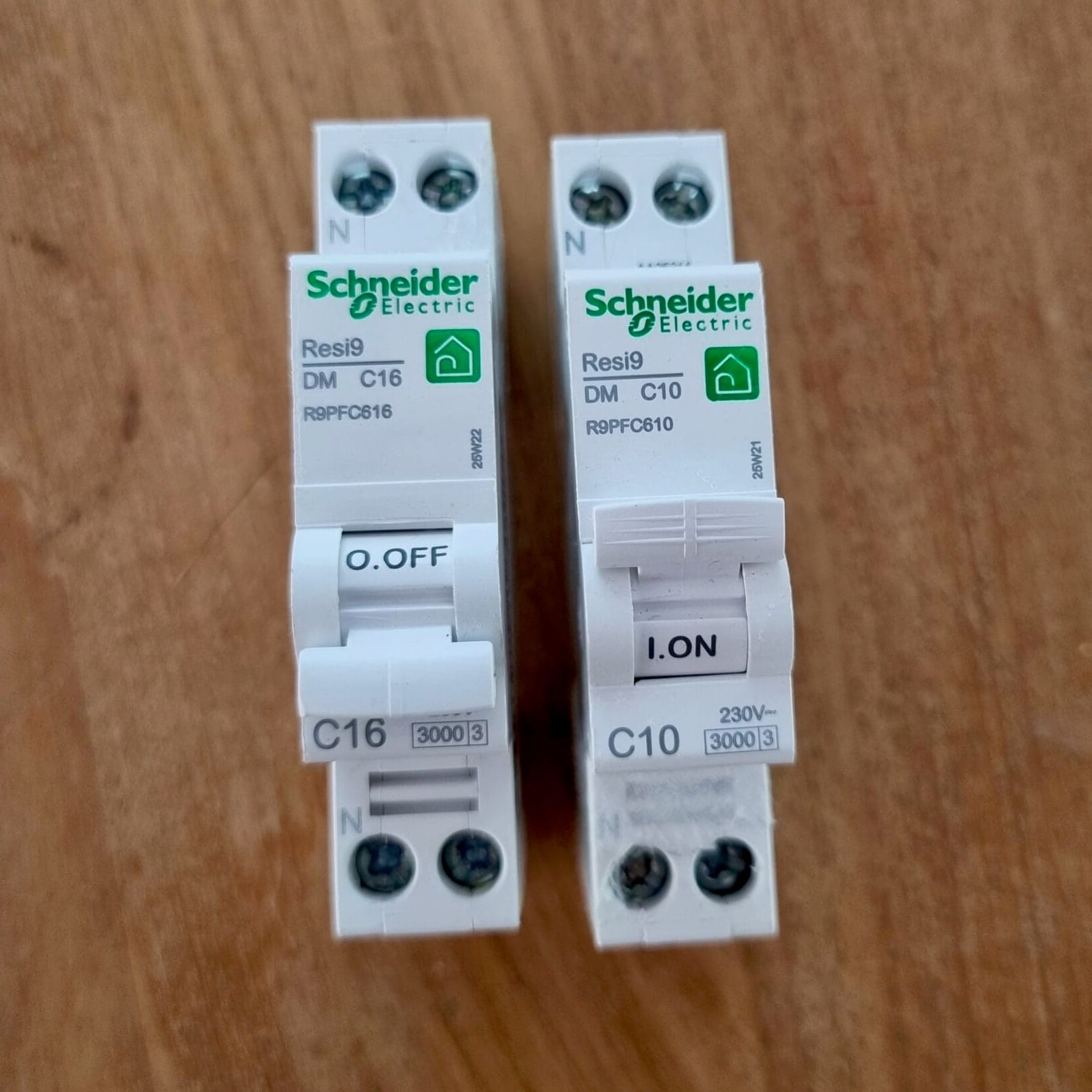
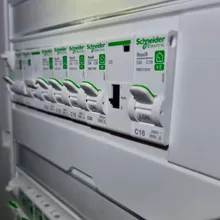
Disjoncteur C16
Le calibre imprimé sur la face doit correspondre à la section du conducteur protégé par ce disjoncteur.
The consumer unit must also keep a spare capacity of at least 20 % of free modules, spread across all rows in a detached house. This reserve exists so that future circuits can be added without rebuilding the board.
The ban targets new installations and major renovations: on an untouched old board, fuses remain legal, and there is no retroactive obligation to replace them.
The moment a project qualifies as a major renovation, the board switches to one MCB per circuit, so I clarify the scope with the client before the first quote, because the difference shows up directly in the parts list.
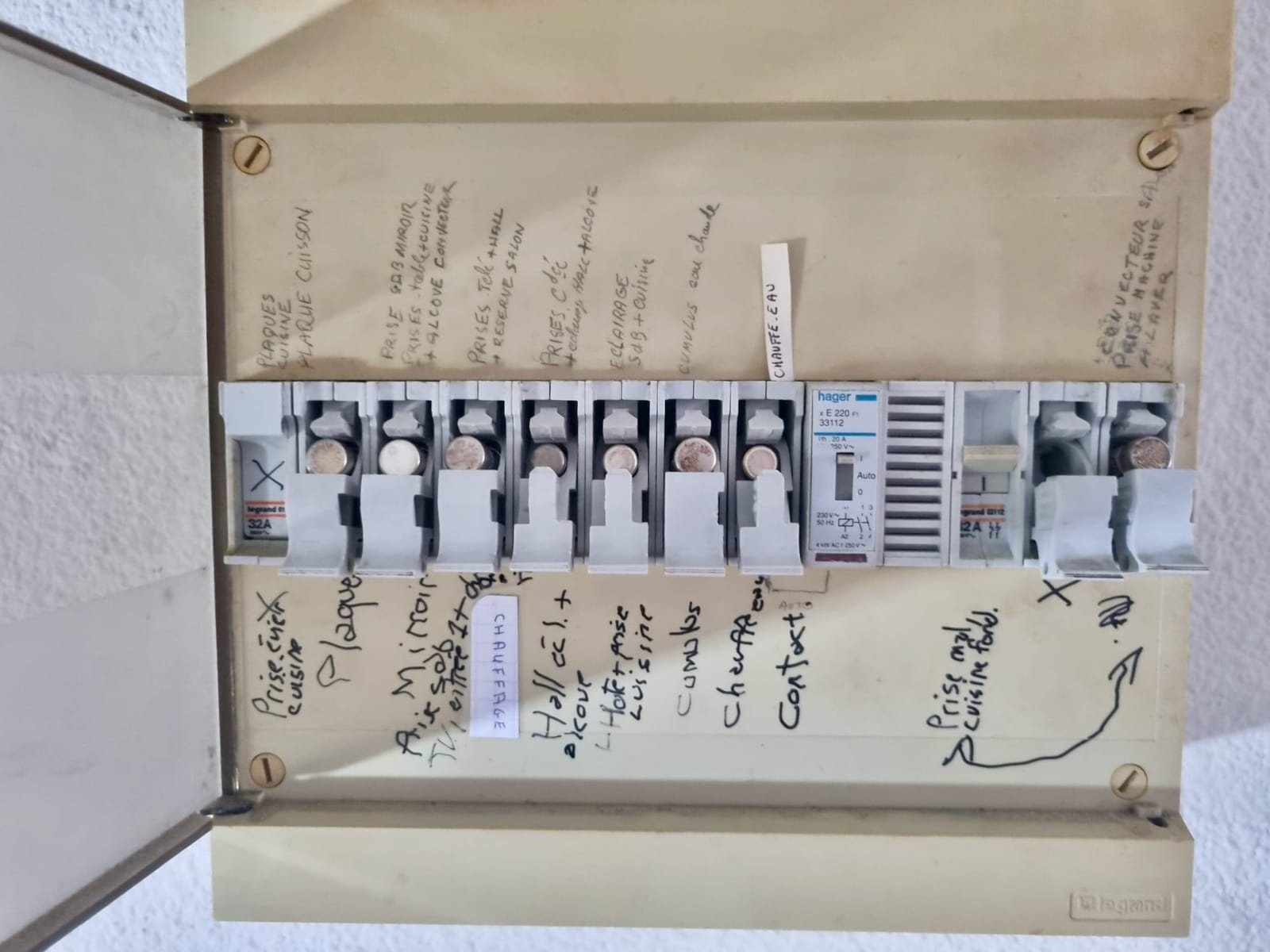
Some English-language guides mention a 30 % spare rule. I checked it against Legrand, who publishes the 20 % figure, and I do not repeat the 30 % value.
When renovating an old board, the practical question of whether to secure or fully upgrade the installation is worth reading before you propose a scope to the client.
Socket circuits follow a maximum-outlet logic. A circuit in 1.5 mm² protected by a 16 A MCB can feed 8 socket outlets maximum; a circuit in 2.5 mm² protected by a 20 A MCB can feed 12 sockets maximum. These figures come from the Legrand FAQ and match what I apply on site.

The cooker hob is always a dedicated circuit in 6 mm² protected at 32 A. The list of circuits that must be dedicated in France — hob, but also water heater, washing machine and others — is long, and I keep a separate article on dedicated circuits with the full list and calibres.
| Circuit | Conductor | Protection | Maximum outlets |
|---|---|---|---|
| Circuit Socket outlets | Conductor 1.5 mm² | Protection 16 A MCB | Maximum outlets 8 sockets |
| Circuit Socket outlets | Conductor 2.5 mm² | Protection 20 A MCB | Maximum outlets 12 sockets |
| Circuit Cooker hob | Conductor 6 mm² | Protection 32 A MCB | Maximum outlets Dedicated circuit |
Verified values from the Legrand FAQ and the dedicated-circuit rules.
For lighting circuits, no single figure applies: English guides circulate 10 A for 1.5 mm², which the official sources do not support, and some French summaries mention 16 A. On this point the standard text is the reference.
Check the standard text before sizing a lighting circuit.
Attention
A circuit sized from an unverified English guide can fail the Consuel visit. When a calibre is not confirmed by an official source, the safe move is to open the standard itself, not to trust a summary page.
The surge protective device (parafoudre) has its own set of French conditions. It is mandatory when the building has a lightning rod, in zone AQ2 under certain conditions, after a lightning risk analysis, and on copper communication networks.
It is recommended when the supply is an overhead line in a department with a keraunic index above 25, or when the building stands less than 50 m from a lightning rod.
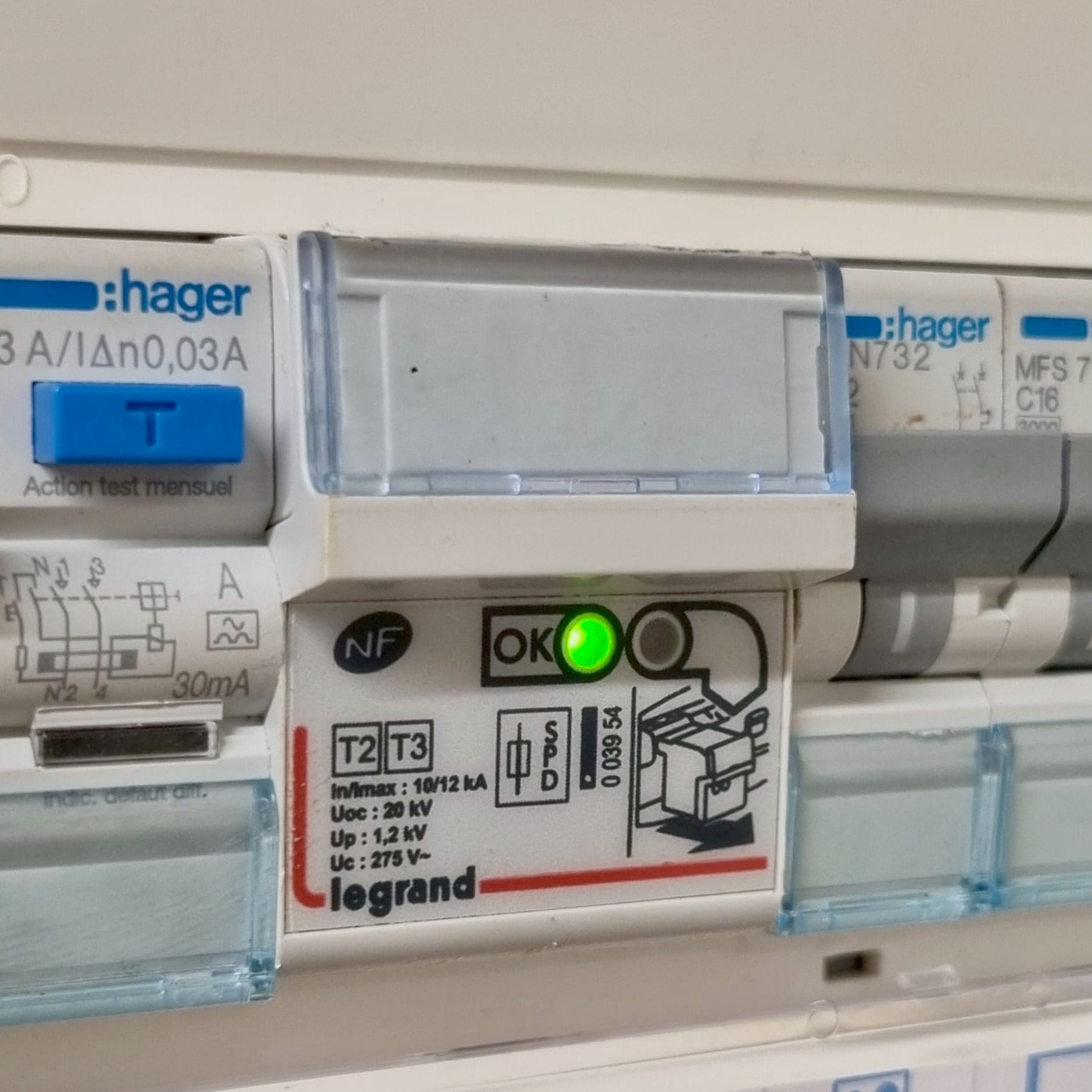
Parafoudre type 2
Identifiez le module de protection contre la foudre dont l'obligation dépend de la zone et du type d'alimentation.
These conditions are more nuanced than a blanket requirement, and they are often misunderstood. On a new board, I verify the zone and the supply type before deciding whether the parafoudre goes in.
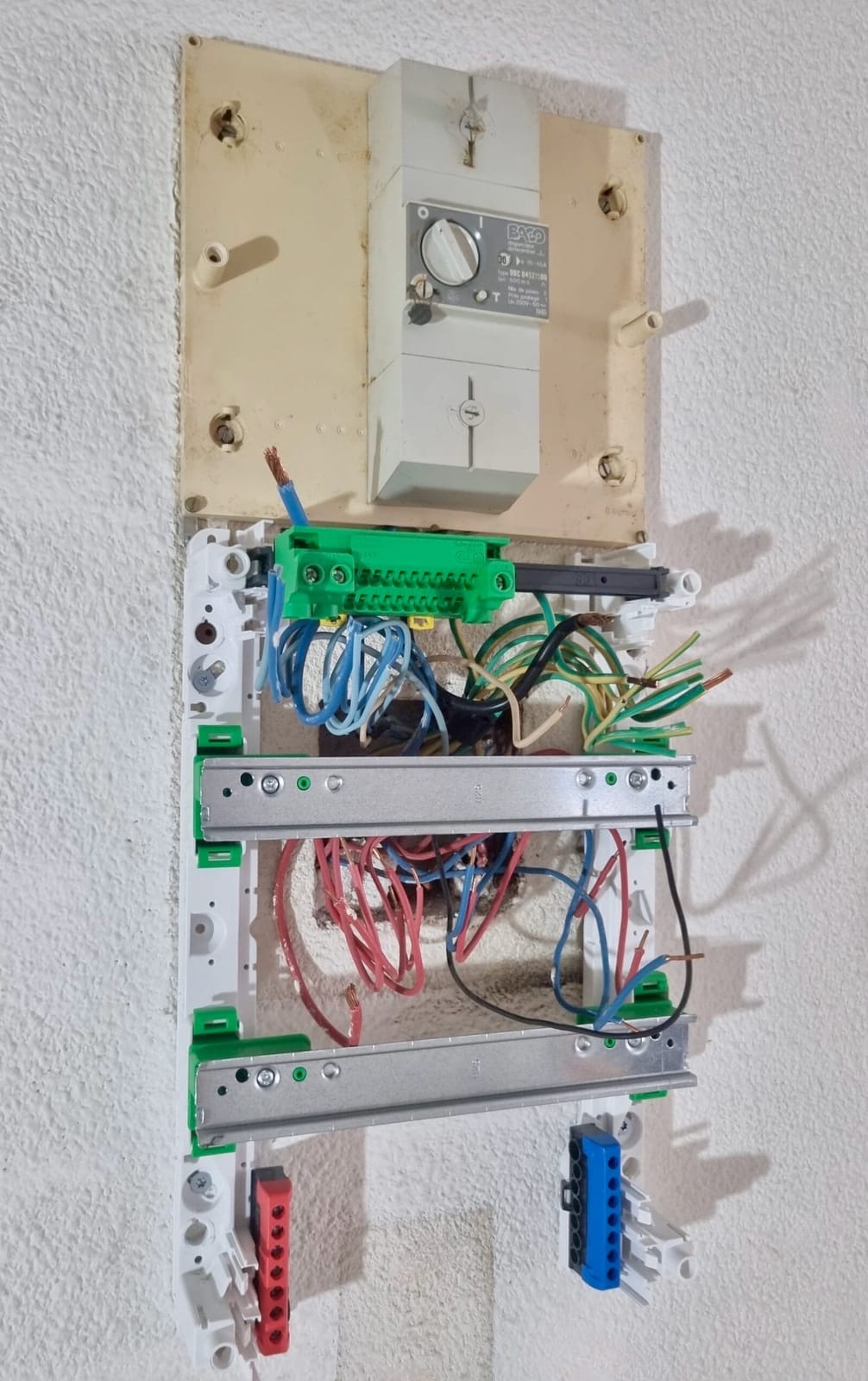
French bathrooms are divided into volumes 0, 1 and 2, each with its own IP ratings and distance rules. Foreign electricians usually know the concept from their own code, but the French zoning boundaries are specific, and the bathroom is one of the rooms where the Consuel visit is the most demanding.
I mention it here because it is part of the panel rules: the board itself is forbidden in the bathroom, and the circuits feeding it are subject to the 30 mA rule like everything else.
Before quoting a bathroom job, I identify the volume in which every socket, switch and luminaire will sit, because the IP rating and the distance rules that apply depend on that volume. It is a quick check on paper, and it is where I have seen the most non-compliances on boards built by colleagues trained abroad.
The most unfamiliar process for foreign electricians is the attestation of conformity. The installer fills a Cerfa attestation, and the distributor refuses to energise the installation until it has been vetted. This pre-energisation control does not exist in many countries.
The obligation was introduced by the decree of 14 December 1972 for new installations, extended to fully renovated installations by the decree of 6 March 2001 — in that case the distributor cuts power until the attestation is accepted — and to production installations below 250 kVA by the decree of 22 March 2010.
Consuel, the body that vets the attestations, is a non-profit association created in 1964. It does not inspect every installation: visits are made by sampling, and a re-inspection is ordered when a major risk is found.
To give you an idea of the scale, Consuel operates with about 200 inspectors, around 180 000 interventions a year, and 13 agencies — nine in metropolitan France and four in the overseas departments.
Conseil
On a renovation, book the attestation step in the schedule from day one. The distributor will not energise without it, and a failed visit means a re-inspection before power can be restored.
There is no retroactive obligation to bring an existing installation up to current standards. The circular of 13 December 1982 provides recommendations for work carried out on existing installations, which is the framework I apply when extending an old circuit without renovating the whole board.
The property transaction is where the rules bite. When a home is sold with an electrical installation older than 15 years, a mandatory electrical condition report is required under article L 134-7 of the construction code, and the report is valid for 3 years.
For a foreign electrician, this report explains why clients ask about the age of their installation at the first meeting.
The difference between making an installation safe and bringing it fully up to code is a real scope question, and the typical faults found in old boards are documented in my diagnostic article.
If you are sizing your first French consumer unit, here is the order I follow. A free French-language configurator also exists if you want to cross-check your layout before ordering parts.
3 questions
InteractifFrench electrical standards explained
3 questions pour vérifier les repères essentiels
Choisissez une réponse
The French panel is not a harder system, it is a more codified one: 30 mA everywhere, two RCDs, eight circuits per RCD, no fuses, a sealed main switch and an attestation before power. Once you know where the figures come from, the logic is consistent.
When in doubt, the standard text — the 2002 edition, freely consultable — is the only authority I trust.
NF C 15-100-10 requires 30 mA sensitivity on every circuit, lighting included, which is broader than BS 7671 or NEC practice in most domestic situations. The rule is enforced through the conformity process: the attestation is vetted by Consuel before the distributor energises, so a circuit without its 30 mA RCD blocks the connection.
At least two: one type A and one type AC, both at 30 mA. Each RCD protects 8 circuits maximum, and the board must have two rows minimum so the loads balance between the two devices.
Not in new work or major renovations: fuses and fuse carriers are banned and replaced by one MCB per circuit. On an old installation that is not being renovated, there is no retroactive obligation to change them.
Per AFNOR, the 2002 edition with amendments A1 to A5 remains mandatory under the order of 3 August 2016. The 2024 series (21 standards) applies to new installations and extensions since September 2025 but not yet referenced in the regulations. Applicable version: the one in force at planning permission or prior declaration filing.
The installer fills a Cerfa attestation required by the distributor before energisation. Consuel, a non-profit body created in 1964, checks them by on-site visits by sampling and orders re-inspection on major risk. The obligation dates from the decree of 14 December 1972, extended to full renovations by the decree of 6 March 2001.
There is no retroactive obligation: the circular of 13 December 1982 only provides recommendations for work on existing installations. However, when a home is sold with an installation older than 15 years, a mandatory electrical condition report under article L 134-7 is required, valid for 3 years.

Théo Desrousseaux
Artisan électricien — Yvelines (78), Hauts-de-Seine (92) et Paris Ouest
Électricien de terrain : installations, mises aux normes et dépannages au quotidien. J'ai fondé Sparx Élec et je dirige son magazine, lu en France et à l'international : chaque article est relu et validé par mes soins avant publication.
Mon parcours → Diplômes et certifications → Charte éditoriale →
Sources officielles et références
Recevez les nouveaux guides
Une notification par semaine dans votre navigateur, sur les nouveaux guides et les changements de norme. Aucune adresse email demandée.
Je vérifie les différentiels 30 mA, la terre et les circuits avant que ça devienne un problème.

Méthode fiable pour reconnaître un compteur monophasé ou triphasé : Linky, facture, disjoncteur, tableau, puissance et pièges à éviter avant devis.
Lire le guide Guide Inter diff ou disjoncteur différentiel Différence entre interrupteur différentiel et disjoncteur différentiel : rôle, prix, norme NF C 15-100 et choix à faire dans un tableau électrique. Lire le guide
  Guide Différentiel type F obligatoire Le différentiel type F détecte les courants composés, résiste aux déclenchements intempestifs et devient exigé pour PAC, clim, pompe de piscine et IRVE. Lire le guide
  Guide Disjoncteur plaque induction 32 A ou 20 A Disjoncteur plaque induction 32 A ou 20 A : règle NF C 15-100, mono ou triphasé, section 6 mm² et erreurs à éviter avant raccordement vraiment sûr. Lire le guide Outil Mon tableau est-il aux normes ? Diagnostiquez surcharge et conformité NF C15-100 en 2 min. Ouvrir l’outil Outil Configurateur tableau électrique Estimez rangées, différentiels et réserve avant d'acheter le tableau. Ouvrir l’outil